
Dr. Ahmed Siddiqi, DO, MBA, FACS, FAAOS
Fellowship-Trained Adult Reconstruction & Joint Specialist
Surgery is the middle of your story.
Dr. Siddiqi is a fellowship-trained hip surgeon and knee surgeon who has performed over 4,100 hip and knee operations. Whether you need a hip replacement, knee replacement, or a revision of a previous surgery, his focus is on getting you back to the life you love.
- Every patient is my only patient: I remember every name, return every call, and ensure zero barriers stand between you and your recovery.
- No fixed alignment ideology: Alignment is tailored to your unique anatomical structure, not a pre-conceived surgeon doctrine.
- The 90/90 Rule: What happens in the 90 days before and 90 days after surgery determines your outcome as much as the procedure itself.
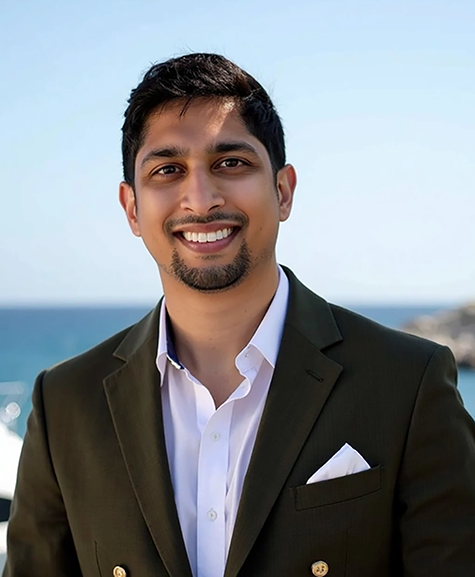
Dr. Ahmed Siddiqi, DO, MBA, FACS, FAAOS
Fellowship-Trained Adult Reconstruction & Joint Specialist
“I watched a physician talk down to my mother when I was a child. I have thought about that interaction in every pre-op conversation I have had since.”
Research & Ideology
Dr. Siddiqi doesn't just practice at the frontier of joint replacement surgery. He's working to move it forward.

Establishing clinical evidence for biological optimization and robotic consistency.
The clinical questions Dr. Siddiqi is working to answer.
Pre-operative biological optimization is not yet a standard of care in joint replacement. The evidence base is developing. The clinical logic is strong. The goal is to close the gap between what the data in practice shows and what the literature can formally support — and to publish that work before anyone else in North Texas does.
The publications and presentations listed below reflect where that work currently stands. The honest answer is that this list will grow. Dr. Siddiqi intends to be the one building it.
On alignment ideology: why Dr. Siddiqi doesn't have a philosophy.
The debate between mechanical, kinematic, and functional alignment in total knee replacement is one of the more productive arguments in the specialty — and one of the more overconfident ones. Surgeons who have committed publicly to a single approach are often arguing for the consistency of their own technique as much as for the evidence. The impulse is understandable. The evidence doesn’t resolve it yet.
Dr. Siddiqi’s approach is anatomy-first and patient-specific. He uses navigation and robotics to execute whatever plan the patient’s anatomy warrants. He does not impose an ideological framework onto a joint that didn’t ask to be part of the debate.

Executing custom robotic planning without dogmatic rigid rules.

Biological clearance beyond basic surgical safety.
On pre-operative optimization: the argument being built.
The standard pre-operative workup in joint replacement is designed to establish one thing: that the patient is safe to operate on. That standard is correct. It is also insufficient — and the insufficiency has consequences that show up in recovery data, not in surgical complication rates.
Whether a patient recovers well — not whether they survive the procedure, but whether they regain function at the rate their biology allows — is determined by variables that a standard clearance workup doesn’t capture. Albumin levels. Inflammatory markers. Nutritional status. Muscle reserve. These are not exotic measures. They are upstream predictors of wound healing, infection risk, and functional recovery.
Dr. Siddiqi is building the publication record to formalize what his practice already demonstrates. He is applying the protocol and documenting the results — which is the correct sequencing for a surgeon who intends to publish first, not last.
On robotics: a consistency instrument, not a precision claim.
The way robotic-assisted joint replacement is marketed — to patients, to hospital systems, to referring physicians — typically emphasizes precision. The robot is presented as more accurate than a human hand, and therefore better. That framing is not wrong, but it is incomplete in a way that matters clinically.
The more important argument is consistency. A skilled surgeon can achieve excellent component positioning manually. The question is whether they achieve it consistently — across a high-volume practice, across a full surgical day, across the range of anatomic variability. The data on that question is where the robotic advantage lives.
Narrowing that variance — as a measurable outcome across a high-volume practice — is the argument Dr. Siddiqi is building toward in the literature.

Sub-millimeter reproducibility across high-volume surgical care.
Publications, Research, & Manuscripts
Explore Dr. Siddiqi's extensive academic contributions to adult reconstruction, periprosthetic infection, robotic alignment, and surgical innovation.